AMAZING ALICE
I am absolutely amazed by Alice Springs and the surrounding area. I was obviously completely ignorant of the general landscape here. I suppose, like most people, I had not consciously thought about what Alice would be like, but in the dim recesses of my mind I had an image of flat, dry, hot, red, dusty plains surrounding a somewhat tumble-down township. That was the visual. On top of that, we were told by innumerable people that the aboriginal people here were not friendly and that drunken and bad behaviour by the locals made visiting the town both unpleasant and dangerous. Goes to show that you should never really take anyone else’s opinion of a place – just go and find out for yourself! I don’t believe I have been sooooooooo totally wrong about anything for quite some time.
From the township perspective, the town is well ordered and has pretty much everything you would wish to find in a remote area town. The aboriginal people we have encountered here have been friendly and welcoming. We have not felt at risk at any time. Certainly alcohol abuse is still evident, but it is now very low key during daylight. We have not ventured out at night. The population here is very multi-cultural as people from all over the world have settled in this area.
Scenically, this is an outstandingly beautiful place. Alice is nestled into a basin within the MacDonnell Ranges. The ranges provide some amazing spectacles including gorges, chasms and spectacular red rocky mounts, hills and rocky outcrops. Thanks to the very wet season just finished, the area is also quite green. We have been very lucky to be here at this time. The Finke River still has quite a bit of water in it making visits to the gorges all the more rewarding.
The only thing I had right, was the red part. I still cannot get past just how red the soil and rocks are here. With the green foliage, bright blue skies and red soils and rocks, the overwhelming effect is one of unspeakable beauty. It almost hurts the eye at times, it is just so incredible! It seems just a bit too dramatic to call it opalesque and yet, that describes it best.
The only negative I can find is that I imagine in the summer, the experience would be totally different. At the moment we are experiencing very cold nights and comfortably sunny days. This means minimal dust and flies. There is an abundance of things to do here. In fact we found that one week really is not quite long enough to see it all. Apart from the wonderful drives out to various scenic spots and historic Hermannsburg, there is also the wonderful Desert Park (a must), the cultural precinct and just so much more. We really didn't do it justice.
On a more practical note, I have been asked to give a brief run-down on the caravan parks we have stayed at. I have been a little reluctant to do this, as I think every experience is very different and coloured by personal preferences etc. On reflection tho’, I see no harm in giving a quick write up on the camps.
In future I will give that description at the end of the relevant blogs and to catch up I will do a special entry just touching on the parks we have stayed at so far. As for Alice, we are staying at the MacDonnell Ranges Holiday Resort. The park is just a little removed from the town and is a 4 star, Big 4 park. The prices are a little steep, especially during peak period, however the park itself is excellent. The bays are huge and most are grassed. There is a special free activity every day, generally at night., ie. Bush ballads, Star Gazing, 4wd talks, etc. If there is a negative at all, we find it a little sterile. It may well be because we are right at the edge of the park and not sitting in the middle of things. The amenities are huge, clean and well appointed. The park is also extremely quiet. Not dog friendly for the poochie people tho’. We would rate this park 8/10.
From here we are off to parts unknown, but generally in the direction of Darwin. Look after yourselves – Stephanie.
Sunday, June 6, 2010


Friday, June 4, 2010
Palm Valley Continued
 Pick the author!!
 Palm Valley
 Palm Valley
 Oops, Palm Valley again -- Sorry!
 Ghost gums against contrasted against the red and blue.
More pics!!
THE DAY WE WENT TO PALM VALLEY
 Heading towards Palm Valley
 Cycad Gorge
 TBBITW himself!!
 Was this the Incas?
 Albert Namitjera's Twin Ghost Gums in reality.
PALM VALLEY
As instructed, we waited in the frosty early morning, our breath billowing before us, hands thrust deep in pockets searching for that elusive warmth.
Alice Springs in early June can be mighty chilly in the dawn. Relationships too can get a little chilly when two people are compelled to spend all day every day in the all too close quarters of a caravan (even when those close quarters are from choice!). Well, chilly, heated, chilly, heated, etc, etc. I am sure you get the general picture. Thus, that morning as we waited for the coach to pick us up, we spoke in short sentences while stomping around in a futile attempt to warm up both ourselves and the conversation.
In good time the coach did come and collect us and we were treated to a better view of Alice than we had previously achieved ourselves, not having to concentrate on directions or trying to avoid yet more caustic conversation relating to streets and dodgy directions. The very quiet guide picked up 4 other groups for the day’s excursion and we headed off for Palm Valley.
The coach was a small one and our guide was a nice young fella by the name of Duncan – he was new at the job and had previously been teaching local aboriginal children and adults for around 10 years. As a self-confessed new-chum he claimed to have minimal knowledge of flora, fauna and geological data, but instead was somewhat of an expert on current aboriginal issues. The other touries were made up of three major groups most of whom were just finishing off camping tours. The general age was around the 60 mark and I sensed some brewing ill feeling between a couple of the female members of one of the groups. The sky was clear as a bell and despite the cold start it promised to be a glorious winter day. My only real problem was that the step into the off-road coach seemed to be impossibly high – why when they deal largely with silver nomads would they not have a step-stool? Anyway with the help of my staunch companion, I managed albeit not too gracefully, to board the bus.
As we headed out to Palm Valley, as usual I completely lost sense of East and West, so will just refer to left and right – I hope that is not too technical for you!
I have always loved the morning and the country here is certainly at its glorious best in the early hours. We travelled through sparse bush, crisp where the sun’s rays were just settling in for the day’s events. To my right, away in the distance crouched the West MacDonnell Ranges. They appeared as huge somnolent beasts, huddled into the earth, clothed in deep purple haze. Tentative fingers of sunlight prodded the soft pink under-belly of the beasts. Spread before them the plains lay open and silver in the morning’s early light, dotted here and there by mulga and Spinifex. In the far distance we could see another range, draped in deep blue and sharply outlined against the icy blue morning sky. We learnt that the fantastic green mantle covering much of the red centre at the moment is ‘Buffle Grass’ – this is an imported pest which is decimating the central Australian bush. It was introduced by pastoralists as cattle feed and had pretty much taken over. One of the biggest problems it causes is, unlike the native flora, it grows aggressively right up to the trunks of the native trees. This makes them much more susceptible to being burned when bush fires occur.
Our first stop for the day was to be historical Hermannsburg where early Lutheran missionaries settled and attempted to educate the local indigenous population in Christianity, health and basic reading and writing. These early settlers appear to have been a little more humane and realistic than other historically reported missionaries. They seem to have really taken the aboriginals’ needs to heart and really did try to make life better (at least in their eyes) for the locals. As with many of these erstwhile endeavours, there were it seems more failures than successes. On the way to Hermannsburg we were told the very sad story of poor Albert Namitjera – there was quite a bit that I hadn’t heard before and from a modern perspective, it is a shocking story indeed.
The countryside from Alice to Hermannsburg was of course, stunning, on the right was the somnolent and distant West MacDonnell Ranges, closer and on the left was ‘Caterpillar Dreaming’. This is a section of the ranges that resembles a caterpillar hunching its way along. In the early morning sunlight the red rocky spine of the caterpillar was shocking as it flaunted its riotous costume. We were told that Aboriginal legend thinks of this section of the ranges as a huge caterpillar crawling across the landscape. It is an easy notion to absorb and it was lovely to think of the giant as ‘Caterpillar Dreaming’! Perhaps this too, explains the multitudes of brightly coloured butterflies we were to see later in the day.
A young colt with glossy coat grazing alongside his dam loitered amongst lush grasses, several other members of the herd grazed a little further along the way. A dead tree came to life, decorated by brilliantly hued budgerigars, native and imported grasses shivered deliciously in the early morning sunlight.
We made a brief comfort stop at Hermannsburg before continuing on our way to Palm Valley. As part of the Federal Intervention introduced by the Howard government, some of the aboriginal homes there have been recently painted bright and cheerful colours. The painting was done by locals and the next project we were told, is to beautify the interior of these homes. The local aboriginal people are encouraged to become involved in improving the community. Duncan (our guide) had been involved with these projects before taking on the job as tour guide. He told us that one of the biggest problems seems to be the inconsistency of policy. No sooner do they get started on one project with promised rewards, than the ‘department’ involved moves the goal posts and the promised rewards vanish – this is of course is a total disincentive to getting the job done. We are told that one of the local sayings is that “White men Lie” – this is the result of all the changes in government and policies. We were also told that when our guide was discussing general issues with an aboriginal friend, he was told “Don’t worry about us, we were here for thousands of years before the white man, and we will be for thousands of years after the white man has gone.” An interesting perspective!
We really only had brief impressions of Hermannsburg at that time, one of those was the high numbers of dogs wandering aimlessly around. Under the intervention, the locals were told they must have no more than 2 dogs, this meant that many dogs were ‘put down’. Looking at the large numbers of un-sterilised hounds, I suspect that the 2 dogs rule might prove very difficult to enforce. It seems they have a great deal of trouble convincing the old women that it is not healthy to sleep with a pile of dogs. Personally, I’m not so sure – after all, it is possibly better than some of the alternatives. At least they will be warm! The other impression I guess, was one of disappointment at the plethora of relatively recent model car wrecks on the roads and in the surrounding bush. I guess change takes a long time sometimes. We were told too, how much the older folk despair of the young ones. For the first time I heard the theory that the western diet is responsible for much of the problem. The youngsters do not do well on high sugar, high salt, high chemical additives – this is probably right, after all city kids suffer to a lesser degree with similar problems.
We were warned that once we left Hermannsburg the road would become very tough indeed. I have to say, young Duncan was a master of understatement! The bitumen disappeared pretty much immediately and we found ourselves bumping along a very sandy and rocky track. There had been substantial rains here recently and the River Finke had been in flood. As with most central Australian rivers, Finke River is generally ‘upside down’, i.e., the water is underground. When in flood however, the river flows like the more traditional rivers we are used to. The road had only been open for 1 week following the flooding, and the resultant damage to roads and tracks was considerable.
The Finke River is estimated to be the oldest river on the planet and of course Australia is the oldest continent that makes this region geographically ancient. Much of the flora subsequently is amazing and often unique. As we fought our way along the rough track, the surrounding countryside began to change. We were literally driving along and often through the river and into the Gorge. The sides around us became increasingly steep. By now the sun was high in the sky. Great crimson sand-stone cliff faces and sheer rock faces reared above us on both sides. The lower reaches were covered by blue and green patchwork, which on closer inspection proved to be emu bush and Spinifex stitched together with golden and silver grasses. The now largely dry river bed was covered with soft silky sand which was coloured soft beige, grey and pink. On close inspection the sand seemed to have been seeded with glitter, it twinkled and gleamed in the winter sun. Along the river bed we saw large trees uprooted by the recent turbulent waters. It was obvious that huge water forces had been at play during the recent downpours. Many pools still remained and much of the water was crystal clear. Tiny fish happily cavorted in the pools along with large pods of tadpoles, all clearly visible to the naked eye. How these creatures manage to survive through decades of drought, when no water pools are available, is incredible.
The bumps and grinds of the coach caused a great deal of consternation among several of the female occupants of the coach – I just found it uncomfortable and a little hard on the spine. I felt that the stunning beauty of our surrounds more than compensated for a little discomfort however.
Crossing over the river at least six times was quite a thrill. Looking down from the coach window I could see streamers of vivid green moss-like material and the quite deep holes in the river.
I cannot really do justice to the scenery. Apart from the ever steepening gorge walls, along the course of the river rose great scarlet and rocky mounds looking like baby volcanoes erupting from the river bed. The sand-stone rocks looked to have been man made in parts and you could easily believe the rocky walls had been constructed by some long gone super race.
The next port of call was for a brief but reasonably tough climb to the top of a small rocky mound for the purpose of taking photos. I must say, I was determined not to be the one who could not complete this climb and am proud to say that with the help of my trusty stick and of course a strong arm from TBBITW I made it to the top. The views from there were exceptional and it was well worth the effort. We stopped and had morning tea at this spot before climbing back into the coach and continuing along an ever deteriorating track to Cycad Gorge. Here we finally left the coach. I have to say there is no way we would subject our beloved Cruiser to this arduous trek. It really was a tough and treacherous drive.
Now we had a relatively long walk along the gorge floor to our destination. Our stopping place was adjacent to an almost sheer rock wall that facing northwards rarely saw direct sunlight. Growing along the rock face were Cycads, one of the oldest plant forms on the earth. The effect of the cycads on the deep red cliff face looking down on to the cool rock pools dotted with a bamboo-like grass was just astounding. The whole effect was tropical and cooling. We are told that Australia was once a very tropical continent and the cycads and palms in this region have survived since prehistoric times due to the permanent water source in this place.
The tops of the cliffs were decorated by white Cyprus and some late flowering plants also grew along the banks and sides of the cliffs. We continued our walk along the gorge floor, mainly thru’ soft red sand, which glittered when caught by the sun. As we walked we were accompanied by the frequent cool rock pools which abounded along the river bed. Sheer red rocks surrounded us, dotted here and there with caves and rock holes. We were told about a huge prehistoric rat that used to frequent the area – I felt sure I could see some droppings of the rat up on some of the higher rock ledges – a suggestion which was met by quite some derision – I’m not convinced that he is not still lurking there. As we rounded the final bend we were confronted by the amazing sight of an abundance of red cabbage palms. Remember we are in the heart of the Red Centre here and the last thing you expect to see are palm trees. The gorge now was fully tropical in appearance – cool green rock pools, tall and elegant palm trees, ancient dark green cycads and Cyprus fringed cliff tops. Bright green bamboo and reeds decorated the pools and the air was cool and refreshing. A whip-bird called in the background and the whole effect was scintillatingly beautiful and not a little surreal. We dallied awhile at the water hole by the palm trees and then sadly had to wend our way back to the coach. On the way back we spotted a large lizard who neatly posted himself into a rock hole on the cliff face as we passed.
Once back at the coach, we retraced our steps back to Hermannsburg where we were to have lunch. The trip back was no less beautiful than the trip in, except by now most of the occupants of the coach had stopped squealing every time we hit a large bump or hole in the road – I think most of us were too pooped to pop!! A couple of small red kangaroos stopped to laugh at us as we bumped past. I was truly sorry to leave that place of exceptional beauty behind us, and have written this so that I can remind myself from time to time of this beautiful day.
Back at Hermannsburg, we were shown a short film about the life of Albert Namitjera – much the same as the information we had been given during the coach tour. We were sat amongst copies of his beautiful water paintings. As the movie was shown in one of the original buildings there, the down-side was that we all froze. Those old buildings are incredibly cool, they must be a boon in the hot summer, but I have to tell you that in the winter they are less than wonderful. Lunch was served and I was pleasantly surprised by a delicious piece of quiche and a crisp salad. Not included in the price, but a definite must was either a home -made scone with jam and cream or a piece of their famous apple strudel. I opted for the scone and cream and was both horrified and amazed when for the paltry sum of $6 I was served not one but two huge hot scones. I do say I, not WE as WE had been horrified at my ordering the scones and had successfully fed my own sense of guilt with some pretty withering looks and gesticulations. Needless to say WE shared the scones and I do believe WE enjoyed them. I was made to believe that I was the only person to indulge – nothing was said by WE when we discovered that pretty much everyone has partaken of one or the other of the treats. We then had 30 mins or so to have a wander around the ruins of Hermannsburg and then it was back on the coach for the trip home.
Coming back was a little bitter-sweet, as the day had been splendid. I was looking forward however, to seeing how my friends the West MacDonnell Ranges would look in a different light. The countryside here changes dramatically in appearance depending on the time of the day. Now the ranges were on our left and the sun was setting pretty much behind them. Now they were cloaked in deep blues and purples, the smaller hills in the forefront almost black in their shadow. In the distance, the steeper deep blue giants bared ribs of silver and pink as they rose skyward.
On our left, crawled the fascinating caterpillars. Still they flaunted themselves in the bright late afternoon sun, their skeletal red bones clawing skyward above skirts of mossy green fringed with deep dark greens and silvers. Here and there graceful ghost gums rose up against the red ochres starkly contrasting their white bones and soft green leaves against the blood red back-ground. We wound ever homeward, finally spearing our way through the ranges and back to the front gate of our caravan park.
All in all, it was a wonderful day, the whole experience complimented by a brilliant and clear blue desert sky. Even the bloke had enjoyed himself and as always the ‘chilly atmosphere’ had evaporated just as it should as the beauty of the surrounding ranges had healed our petty differences.
MORE PICS
 The ranges at sundown - from the front of the van.
 Looking up at Kings Canyon.
 Brave (and fit) Rim Walkers at the canyon.
 Looking skyward.
 The range against the stormy afternoon sky (from the van).
Just thought I would give a few more photos - the system only allows for 5 per blog, so we are a bit limited. Too good to miss out on I thought!!
Thursday, June 3, 2010
THE KING AND I
 Rocky overhangs at the Canyon.

Dry river bed inside the canyon.
 Dingo wandering around inside the Resort.
 From the van door.
 From inside the van, thru' the window above the bed!
THE KING AND I
Hi again everyone – hope you didn’t miss me!! I know, I know, the blogs are coming a bit fast at the moment – it’s just that I have to do them while I have access to the net – as you are no doubt aware, access is a bit erratic out here in the ‘Never Never’. After Alice, it is possible you will have a break for a while as we will be out of range for a little while.
Well, Kings Canyon – unbelievable!! We stayed at the resort (in the caravan section) and once again our site was fantastic – we had a spot directly overlooking the range – I have included a shot we took from inside the caravan looking across the bed and out to the rugged hills.
You are going to get very sick of me telling you just how beautiful this part of the country is – I’m sorry, but as I am just so impressed it is very difficult not to harp on about it.
There are two walks at Kings Canyon, a very difficult one, the Rim Walk and an easier one thru’ the floor of the gorge. We did the floor, my knee was still too sore to attempt the harder walk. Truth be told, until I can arrange to get a knee replacement, I don’t think I am going to be able to do some of these steeper climbs. The going up is just a matter of fitness, the coming back down tho’ is pretty much mission impossible for me at the moment. It is a shame as I am sure I will miss some outstanding views as a result of this impediment. TBBITW has so far opted to stay with me on the lesser walks – I dare say he will move onto the harder ones when he finds a mate to climb with.
Having said all of that, I must point out that in my humble opinion the walk thru’ the canyon floor was absolutely fantastic and I was more than happy with the experience. I have included some photos of the walk (hopefully) so you can see the beauty of the place.
Well, I finally had my ‘dingo’ fix. They were more than plentiful at the Kings Canyon Resort, coming into camp late afternoon and again in the early morning. One casual fellow wandered into camp around 6 in the evening and simply lay down between two caravans for a kip!! The howling of the dingos is both eerie and beautiful. According to the local experts the mating season lasts up to late May (when we were there) and during that time the boys are not particularly interested in tucker and can drop a large percentage of their body weight. Something I didn’t realise is that dingos mate for life. They somehow seem all the more admirable for that don’t you think?
The weather when we arrived at King’s Canyon was heavily overcast and we did have a little rain that evening, apart from that tho’ we have continued to be blessed with chilly nights and absolutely marvellous days – clear and crisp in the morning, warming up to mid 20s during the middle of the day – I really could live with that forever I think. TBBITW is finding the chilly nights a bit much, but personally I just love them.
My next blog will be from Alice – until then love yourselves, love each other and love the world around you – Stephanie.
UNFORGETTABLE ULURU
 Wild camels grazing at the Olgas
 The Olgas in the morning light
 People climbing the rock (double click the photo to view).
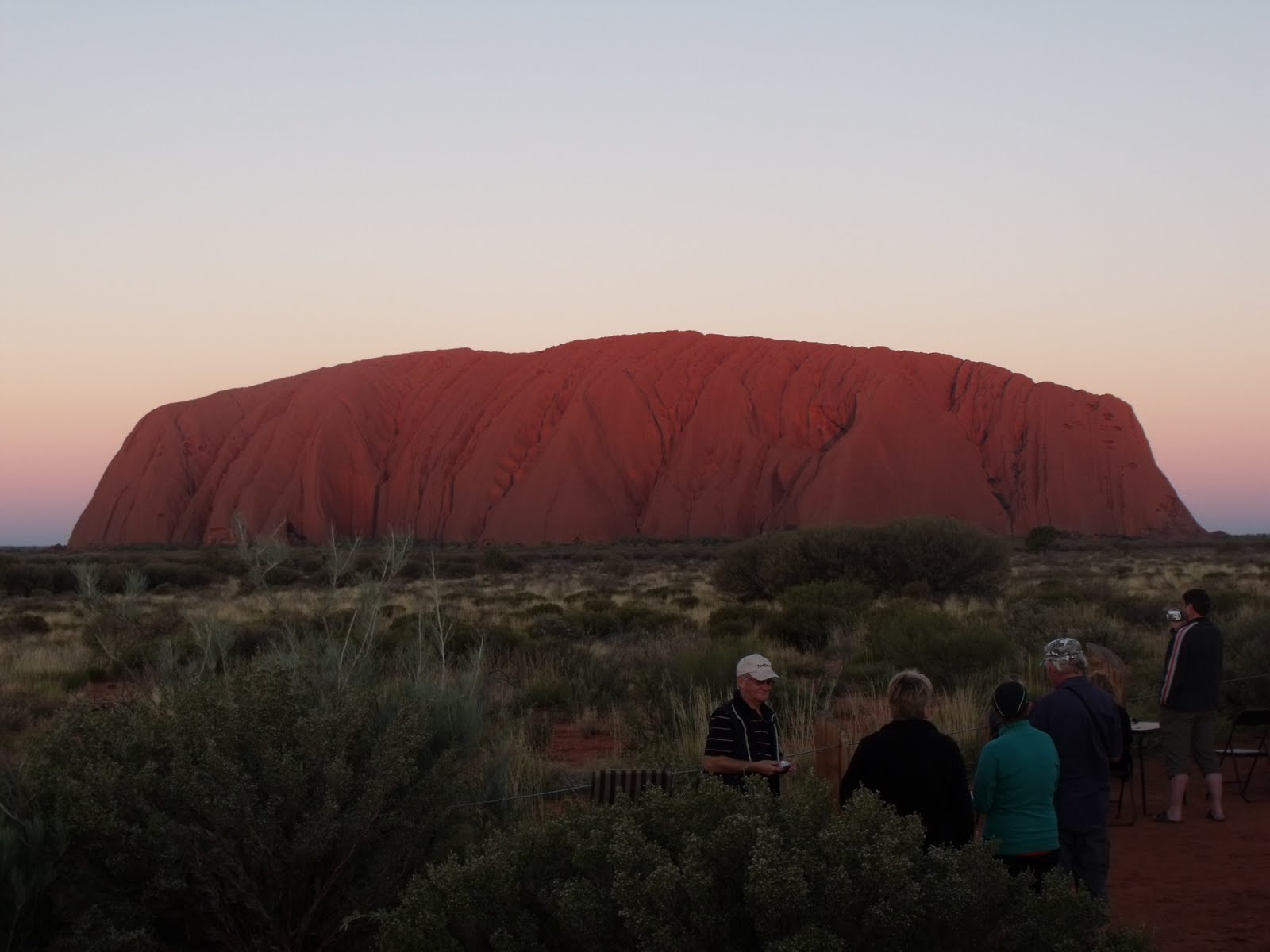 Awsome Uluru - sunset.
 Uluru in full sun late afternoon.
UNFORGETTABLE ULURU
HELLO!! WOW!!!!!!!! You know it is absolutely amazing. I must have seen hundreds of photos and pictures of ‘The Rock’ over my considerable years and yet I was completely blown-away by the sheer majesty and beauty of the place. I know I have said this before, but the colours out here are remarkable. The best season they say for 40 odd years and there is green everywhere – except of course on the rock. Uluru is wonderful – of course, like everyone else, we took hundreds of photos all at different times of the day – I have only included minimal of these, as like me you will have seen it all before and until you come and see it yourself you still will not believe it. What we didn’t realise tho’ was the tradition of taking your comfy seats, a little table, the bottle of bubbly or chards and your nibbles and spending a pleasant hour or so watching the magnificent light display as the sun goes down. We were not at all properly prepared when we went out at sunset, however, we did still get the photos and did still enjoy the spectacle. Not so much to be said for the sunrise however. It is said that the viewing platform which apparently cost a small fortune to erect, is in the wrong spot – I can well believe that – the sunrise was not displayed to advantage from the platform. I guess that for me, it was also spoilt by the absolute multitudes with who I shared the spectacle. We had not realised until we arrived at Uluru how much of a tourist magnet it is. We were not entirely thrilled to be back amongst the hordes and to be charged the ‘tourist dollar’ for everything we saw and did at the rock. Mind you, neither TBBITW nor I will complain about the $25 it costs to go to see Uluru. The $25 covers your entry into a significantly large portion of land which includes the Olgas for a full three days – when you are there you have the advantage of a manned first aid station amongst other things plus the park is very well maintained and apart from some rather obscure signage is very well run. We were pretty horrified with all the complaints we heard.
The Olgas were incredibly beautiful – I think in fact I preferred them to Uluru. The shadows and hues of the rocks there were unforgettable. It is truly humbling to think of the venerable age of this country. We didn’t do the ‘Valley of the Winds’ walk as we thought it might be a bit too tough for us. This consideration was aided and abetted by the fact that I put my very big fat foot into a little hole outside the van the morning we were going and managed to fall over, nearly cleaning up the washing machine in the process. Result? Oh a couple of sore ankles and wrists, together with an even more painful knee than before. We did do the Walpa Gorge walk tho’ and I am pleased to say I managed very well all things considered. The gorge was stunning – it’s hard to believe these fascinating places and lush places are here in the middle of the country and desert areas.
The camp at Yulara (next to Uluru) was very good and we had a great spot yet again – we continue to be very jammy with the places we get to park the van. We do prefer to be on the outskirts of the parks and we were right at the outside edge of the caravan park. It seemed a shame that they had t he park fenced, but I guess it is a matter of necessity – largely to keep us from desecrating the bushland I would think. The number of people passing thru’ the park would be devastating if not properly contained or perhaps that should read - constrained!
We have had a good run spotting wild-life. There is not too much we haven’t been able to cross off our ‘critters’ list. We have seen brumbies, roos, emus, camels and although I have not yet seen a dingo, TBBITW did spot one wandering thru’ the camp at Uluru. Certainly they did give wonderful sound effects around the rock and surrounds in the evening and early morning. It was quite surreal listening to them while lying in bed.
Well, bye for now and see you soon at Kings Canyon. Stephanie. Smile!!
Tuesday, May 25, 2010
CAPTIVATING COOBER PEDY
 The Painted Desert - all natural!
 The photos do not do justice to the colours here - once again - all nature's work.
 Orthodox Croatian Chapel - all hand made/cut - absolutely amazing.
 COLOUR!!!!!! This is how it looks to the lucky miner who finds a good strike.
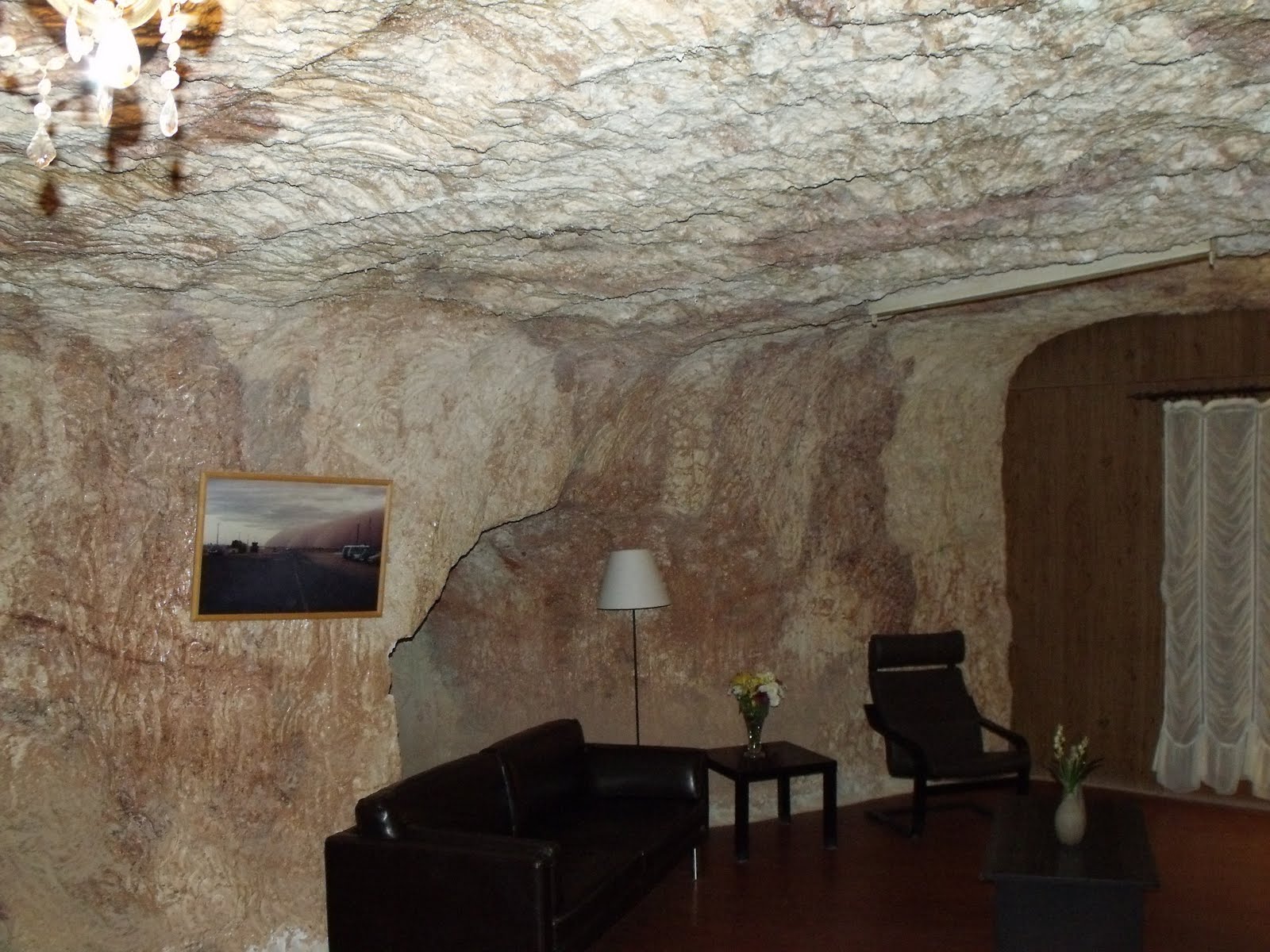 Home Sweet Home!
Hi again folks, how is life treating you? We continue to be blessed with good fortune and great experiences. Our most recent adventure was Coober Pedy. For anyone out there who perhaps doesn’t realise, Coober Pedy is wholly and solely an Opal Mining Town (except, these days, for a huge tourism industry).
I cannot tell you it is unique, but to the best of my (very limited) knowledge, the structure of the town is like none other. I knew that most of the people lived underground there, but just could not picture how that would look. Now that I have seen it, I am finding it difficult to describe. The town itself is largely above ground – when I say town, I mean the few commercial enterprises that are strewn down the main street. Some of the commercial and most of the residential is under-ground. The residential area resembles nothing more than something like a gravel pit. Truly, the streets are mainly unpaved and just meander amongst large mounds of earth. Some of the mounds are man-made, but mostly they are a natural occurrence. In the front and to the sides of these mounds (often partially hidden) are door-ways. These are homes. The only other give-away that people live there are the manifold pipes sticking up out of the hills – these are air vents. Not in your wildest dreams could you call the place attractive, but it is absolutely fascinating. Coober Pedy is a melting pot of nationalities, I think I remember them telling me there were 60 different nations represented there. Many are represented by clubs which abound there. There is a very large police presence, although we were told by our erstwhile guide, that is simply because of the vast area/precinct covered by that particular police station. I think that perhaps also the place is, or has been, very lawless, much like the ‘wild, wild west’ often depicted in the movies. A couple of little antidotes that may illustrate this point were that firstly, policemen never live underground – the reason? Because it is too easy for miscreants to drop explosives (very readily available there) down their air-vents (the air vents on the homes silly, not on the policemen!) . Secondly, if anyone is caught trespassing in a tunnel that is not theirs, they are ‘bombed’ out of the tunnel! As I said, a pretty lawless place!
We felt that the best way to see such an unusual place was to take one of the professional tours – this we did and we were very impressed with both the quality and the value. The tour took 4 hours and covered pretty much everything. I have included photos taken on the tour. You will see the inside of a home, a church and an old mine. You will notice that the photo of the mine shows a line of ‘colour’ – this is what opal looks like while still in the ground. If you click on the photo and enlarge it, you should get a pretty good image. The tour took us out to some of the more heavily worked areas where you really wouldn’t want to go for a walk due to all the holes in the ground and the instability of the ground due to the manifest tunnelling. We also went out to the Painted Desert where it looks like man has been mining, but in actual fact it is all natures work. TBBITW took a great photo of the ‘dog fence’ – this runs for some amazing length and is designed to keep out dingos and wild dogs. The odd thing is that when I asked which side of the fence the dogs are on, I was told both sides – and yet they maintain this fence diligently!! Still haven’t worked that one out.
One of the lessons we are learning is not to listen to what other people tell you. Impressions are biased by personal taste and often completely different to our own. We had been told that Cooper Pedy was a problem town and that there was an ‘indigenous’ problem there. Well folks, there were a few inebriated types around on Friday afternoon, but by and large we found that the local indigenous population was doing what everyone else was doing, working and bringing up their families. There seem to be a small core of people in town who are ‘lost’, but that is all.
The caravan park we stayed at (Stuart Range) was very good indeed. Clean amenities, good bays and brilliant pizzas! Yes, I did say pizzas. It is a strange thing, but TBBITW does not like pizzas and as a result, I had not had one for almost 8 years. Yet, in Coober Pedy we broke the pizza drought. The family who own and manage the caravan park moved there from Melbourne some 40 years ago. In Melbourne (the Aussie home of pizza) they had a pizza parlour. They have continued that family tradition in CP – and I have to tell you, they do a great job.
In case you are wondering, TBBITW did break down and buy me a very pretty opal pendant. I confess to having a passion for opal, but am aware that there is a tourist trap there and there is absolutely no guarantee that what you are getting is either good or the real McCoy. Needless to say, despite all that, once confronted by a myriad of the beautiful gems, I was very, very keen to own one.
We only stayed in CP for two days, that pretty much covers the place, particularly having taken the tour. From Coober Pedy we travelled on to Uluru – exciting? Yes, but I will save it for the next blog.
Take care and don’t get moon-struck – Steph.
Subscribe to:
Posts (Atom)